
No products
Product successfully added to your shopping cart
There are 0 items in your cart. There is 1 item in your cart.
5HT Receptors
- Protein Control Ligand
- Pathway Inhibitors
- Enzyme Inhibitors
- Kinase Inhibitors
- Protease
- Synthase
- p18
- p38
- p53
- p70
- p90
- Peptidase
- Carboxyl and Decarboxylases
- Ceramide Turnover Enzymes
- Chromatin Modifying Enzymes
- Cyclic Nucleotide Turnover Enzymes
- Glycerophospholipid Turnover Enzymes
- Hydroxylases
- Ubiquitin-Activating Enzyme
- Adenosine Deaminase
- Clathrin
- Nuclease
- p68
- ACE
- COX
- DHFR
- Neprilysin
- NF-κB
- RAF
- RAS
- Reductase
- ROR
- Topoisomerase
- Transferase
- Protein Inhibitors
- Transporter Inhibitors
- Cell Inhibition
- Synthase
- Receptor Tyrosine Phosphatases (RTP)
- AChE
- Peptidase
- Autophagy
- Toll-Like Receptor (TLR)
- Enzyme Inhibitors
- Function Modulators
- Activators
- G Protein-Coupled Receptor Ligands
- 5HT Receptors
- Adrenoceptor
- Angiotensin Receptor
- Cannabinoid Receptors
- CCK Receptors
- DA Receptors
- EAA Receptors
- Ghrelin Receptors
- GABA Receptors
- Histamine Receptors
- Leukotriene Receptors
- Metabotropic Glutamate Receptors
- Motilin Receptors
- Muscarinic Receptor
- Neuropeptide Receptors
- Opioid Receptors
- Orexin Receptors
- Orphan Receptors
- Prostanoid Receptors
- Proteinase-Activated Receptors
- Purinergic Receptors
- Ryanodine receptor
- Sigma Receptors
- Thrombin Receptor
- Vaniloid Receptor
- VIP and PACAP Receptors
- Neurotensin Receptors
- Urotensin Receptor
- Imidazoline receptor
- SMO Receptors
- Apelin Receptor
- β-arrestin/β2-adaptin
- KDM4
- Glucocorticoid Receptor
- Laminin Receptor
- AHR
- Amylin Receptor
- Bombesin Receptor
- Bradykinin Receptor
- CFTR
- CGRP Receptor
- CRFR
- Endothelin Receptor
- Ephrin Receptor
- Farnesoid X receptor (FXR)
- Glucagon Receptor
- Nuclear Receptor Ligands
- GDNF Receptors
- TNF Receptors
- Transcription Factors
- Chemokines
- Cytokine Receptors
- Biomarkers and Buffer Solutions
- Molecular Probes
- Stem Cell Research
- Alzheimer's Disease
- Apoptosis
- Cancer Research
- Epigenetics
- Metabolites
- PET/SPECT Imaging Precursors
- Customized Screening Library
- Ultra Pure Pharmacological Standard
- Tissue Microarray (TMA)
- Proteins and Antibodies
- Primary Cells
- ELISA KIT
- Natural Products
- Lab Equipments
- Humanized Mice for PDX Platform
- Rare Chemicals
- Custom Synthesis
- Antibacterial
- Antifungal
- Antioxidant
- Antiviral
- Molecular Glues
- PROTAC Linker
- SARS-CoV
 View larger
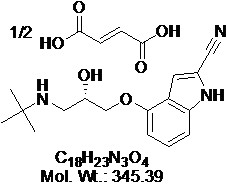
 S(-)-Cyanopindolol hemifumarate
AOB5699
CAS No : 874882-72-1
Chemical Name: 4-[3-[(1,1-Dimethylethyl)amino]-2-hydroxypropoxy]-1H-indole-2-carbonitrile hemifumarate salt
480 Items
Molarity Calculation Cart®
HOW TO ORDER
Quantity Discount Table - Order More To Get More Price Discount
| Quantity | mg | Unit Price ($/mg or $/Unit) | Final Price |
|---|---|---|---|
| 1 | 5 | $33.15 | Total: $165.75 |
| 1 | 10 | $28.08 | Total: $280.80 |
| 1 | 25 | $23.79 | Total: $594.75 |
| 1 | 50 | $20.28 | Total: $1,014.00 |
| 1 | 100 | $17.55 | Total: $1,755.00 |
Data sheet
| Molecular Formula | C32H42N6O4·C4H4O4 |
| Molecular Weight | 690.79 |
| CAS Numbers | 874882-72-1 |
| Storage Condition | 0°C (short term), -20°C (long term), desiccated |
| Solubility | DMSO and Water |
| Purity | 98% by HPLC |
More info
5-HT1A/1B serotonin receptor antagonist; β3-adrenoceptor antagonist
S(–)-Cyanopindolol hemifumarate is a pharmacological research compound used primarily as a high-affinity ligand for certain G-protein-coupled receptors (GPCRs). It is not used clinically, but has been important in basic receptor characterization and pharmacology studies.
Primary Functional Activities
β-Adrenergic Receptor Antagonist / Ligand
• It binds with high affinity to β-adrenergic receptors (β₁ and β₂ subtypes) found in cardiovascular and other tissues.
• Functionally it blocks (antagonizes) activation by endogenous agonists such as adrenaline/noradrenaline, preventing downstream signalling (e.g., cAMP production via Gs proteins).Serotonin (5-HT) Receptor Antagonist
• It is also a potent antagonist at serotonin receptor subtypes 5-HT₁A and 5-HT₁B — receptors involved in regulating serotonin release and neuronal signalling.
• Blocking these autoreceptors can increase synaptic serotonin by reducing inhibitory feedback, a mechanism explored in neuroscience research.
Pharmacological Features
Antagonism vs Partial Agonism: While mainly categorized as an antagonist, in some experimental systems S(–)-Cyanopindolol shows weak partial agonist or inverse agonist behavior depending on receptor subtype, expression level, and system context.
High Binding Affinity: Its strong affinity for β-adrenoceptors has made it useful as a radioligand (when labeled with isotopes like ¹²⁵I) to quantify receptor density and subtype distribution in tissues.
Structural Research Tool: Crystallographic studies of the β-adrenergic receptor bound to cyanopindolol have helped elucidate how antagonists stabilize inactive receptor conformations and identify key binding interactions.
Receptor Interaction Summary
| Receptor Type | Interaction |
|---|---|
| β₁ / β₂-Adrenergic Receptors | High-affinity antagonist/weak partial agonist |
| 5-HT₁A / 5-HT₁B Serotonin Receptors | High-affinity antagonist |
| Other GPCRs | Lower affinity or variable effects depending on subtype |