
No products
Product successfully added to your shopping cart
There are 0 items in your cart. There is 1 item in your cart.
Function Modulators
- Protein Control Ligand
- Pathway Inhibitors
- Enzyme Inhibitors
- Kinase Inhibitors
- Protease
- Synthase
- p18
- p38
- p53
- p70
- p90
- Peptidase
- Carboxyl and Decarboxylases
- Ceramide Turnover Enzymes
- Chromatin Modifying Enzymes
- Cyclic Nucleotide Turnover Enzymes
- Glycerophospholipid Turnover Enzymes
- Hydroxylases
- Ubiquitin-Activating Enzyme
- Adenosine Deaminase
- Clathrin
- Nuclease
- p68
- ACE
- COX
- DHFR
- Neprilysin
- NF-κB
- RAF
- RAS
- Reductase
- ROR
- Topoisomerase
- Transferase
- Protein Inhibitors
- Transporter Inhibitors
- Cell Inhibition
- Synthase
- Receptor Tyrosine Phosphatases (RTP)
- AChE
- Peptidase
- Autophagy
- Toll-Like Receptor (TLR)
- Enzyme Inhibitors
- Function Modulators
- Activators
- G Protein-Coupled Receptor Ligands
- 5HT Receptors
- Adrenoceptor
- Angiotensin Receptor
- Cannabinoid Receptors
- CCK Receptors
- DA Receptors
- EAA Receptors
- Ghrelin Receptors
- GABA Receptors
- Histamine Receptors
- Leukotriene Receptors
- Metabotropic Glutamate Receptors
- Motilin Receptors
- Muscarinic Receptor
- Neuropeptide Receptors
- Opioid Receptors
- Orexin Receptors
- Orphan Receptors
- Prostanoid Receptors
- Proteinase-Activated Receptors
- Purinergic Receptors
- Ryanodine receptor
- Sigma Receptors
- Thrombin Receptor
- Vaniloid Receptor
- VIP and PACAP Receptors
- Neurotensin Receptors
- Urotensin Receptor
- Imidazoline receptor
- SMO Receptors
- Apelin Receptor
- β-arrestin/β2-adaptin
- KDM4
- Glucocorticoid Receptor
- Laminin Receptor
- AHR
- Amylin Receptor
- Bombesin Receptor
- Bradykinin Receptor
- CFTR
- CGRP Receptor
- CRFR
- Endothelin Receptor
- Ephrin Receptor
- Farnesoid X receptor (FXR)
- Glucagon Receptor
- Nuclear Receptor Ligands
- GDNF Receptors
- TNF Receptors
- Transcription Factors
- Chemokines
- Cytokine Receptors
- Biomarkers and Buffer Solutions
- Molecular Probes
- Stem Cell Research
- Alzheimer's Disease
- Apoptosis
- Cancer Research
- Epigenetics
- Metabolites
- PET/SPECT Imaging Precursors
- Customized Screening Library
- Ultra Pure Pharmacological Standard
- Tissue Microarray (TMA)
- Proteins and Antibodies
- Primary Cells
- ELISA KIT
- Natural Products
- Lab Equipments
- Humanized Mice for PDX Platform
- Rare Chemicals
- Custom Synthesis
- Antibacterial
- Antifungal
- Antioxidant
- Antiviral
- Molecular Glues
- PROTAC Linker
- SARS-CoV
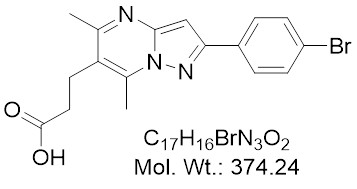 View larger
 CRT0063465
AOB13255
CAS N/A
Chemical Name: 3-(2-(4-Bromophenyl)-5,7-dimethylpyrazolo[1,5-a]pyrimidin-6-yl)propanoic acid
1000 Items
Molarity Calculation Cart®
HOW TO ORDER
Quantity Discount Table - Order More To Get More Price Discount
| Quantity | mg | Unit Price ($/mg or $/Unit) | Final Price |
|---|---|---|---|
| 1 | 5 | $17.85 | Total: $89.25 |
| 1 | 10 | $15.12 | Total: $151.20 |
| 1 | 25 | $12.81 | Total: $320.25 |
| 1 | 50 | $10.92 | Total: $546.00 |
| 1 | 100 | $9.45 | Total: $945.00 |
Data sheet
| Molecular Formula | C17H16BrN3O2 |
| Molecular Weight | 374.24 |
| Synonym | CRT0063465; CRT-0063465; CRT 0063465 |
| IUPAC/Chemical Name | 3-(2-(4-Bromophenyl)-5,7-dimethylpyrazolo[1,5-a]pyrimidin-6-yl)propanoic acid |
| InChl Key | SJELVUFWTXHLTJ-UHFFFAOYSA-N |
| InChl Code | InChI=1S/C17H16BrN3O2/c1-10-14(7-8-17(22)23)11(2)21-16(19-10)9-15(20-21)12-3-5-13(18)6-4-12/h3-6,9H,7-8H2,1-2H3,(H,22,23) |
| SMILES Code | O=C(O)CCC1=C(C)N2C(N=C1C)=CC(C3=CC=C(Br)C=C3)=N2 |
More info
Novel Ligand of Human PGK1 and Stress Sensor DJ1, Modulating the Shelterin Complex and Telomere Length Regulation
What is CRT0063465?
CRT0063465 is a pyrazolopyrimidine small molecule. PubMed+2PMC+2
It was identified in screens aimed at modulating “immortality” / telomere regulation. PubMed+1
Known Molecular Targets
Phosphoglycerate Kinase 1 (PGK1): A glycolytic enzyme. CRT0063465 binds to PGK1, with a measured KdK_dKd of ~24 µM.
DJ-1 (PARK7): A stress-response protein / oxidative stress sensor. The compound also interacts with DJ-1. PMC
Moreover, there is evidence that PGK1 and DJ-1 physically interact (they form a complex), and CRT0063465 modulates this interaction. PubMed+1
Mechanism & Functional Effects
From the key study (Bilsland et al., Neoplasia, 2019): PubMed
Binding to PGK1 alters conformation
Modulating Telomere Biology / Shelterin
PGK1 and DJ-1 were found to bind to TRF2, a core component of the telomere-protecting shelterin complex. PubMed+1
Treatment with CRT0063465 changes the composition of the shelterin complex (i.e., which proteins are associated), which suggests the compound influences telomere architecture. PMC
Under hypoglycemic stress (low glucose), CRT0063465 blocks telomere shortening in HCT116 cells. PubMed
Importantly, this effect is independent of telomerase activity—the compound does not work by reactivating telomerase. PMC
Cytoprotective Effects
Biological / Therapeutic Implications
The data suggest a cross-talk between metabolism (glycolysis) and telomere maintenance: by binding PGK1 and DJ-1, CRT0063465 influences how cells regulate telomeres under metabolic stress. PMC
Because telomere shortening is associated with aging, cellular stress, and cancer, modulating shelterin composition could have potential in chemoprevention or in diseases tied to telomere dysfunction. PubMed+1
Its cytoprotective effects under genotoxic stress (bleomycin) or iron-stress (DFO) hint at a potential role in protecting cells in stressful environments.
Limitations / Considerations
The compound’s affinity for PGK1 is relatively modest (Kd ~24 µM), so in vitro effects might require careful dosing. PubMed
Although there is structural data and some mechanistic insight, the full physiological role of the PGK1–DJ1 complex and how CRT0063465’s modulation translates in vivo is not fully established.
As of the key study, CRT0063465 is used in cell lines and in stress models; there's no (publicly disclosed) clinical development or therapeutic use.