
No products
Product successfully added to your shopping cart
There are 0 items in your cart. There is 1 item in your cart.
Function Modulators
- Protein Control Ligand
- Pathway Inhibitors
- Enzyme Inhibitors
- Kinase Inhibitors
- Protease
- Synthase
- p18
- p38
- p53
- p70
- p90
- Peptidase
- Carboxyl and Decarboxylases
- Ceramide Turnover Enzymes
- Chromatin Modifying Enzymes
- Cyclic Nucleotide Turnover Enzymes
- Glycerophospholipid Turnover Enzymes
- Hydroxylases
- Ubiquitin-Activating Enzyme
- Adenosine Deaminase
- Clathrin
- Nuclease
- p68
- ACE
- COX
- DHFR
- Neprilysin
- NF-κB
- RAF
- RAS
- Reductase
- ROR
- Topoisomerase
- Transferase
- Protein Inhibitors
- Transporter Inhibitors
- Cell Inhibition
- Synthase
- Receptor Tyrosine Phosphatases (RTP)
- AChE
- Peptidase
- Autophagy
- Toll-Like Receptor (TLR)
- Enzyme Inhibitors
- Function Modulators
- Activators
- G Protein-Coupled Receptor Ligands
- 5HT Receptors
- Adrenoceptor
- Angiotensin Receptor
- Cannabinoid Receptors
- CCK Receptors
- DA Receptors
- EAA Receptors
- Ghrelin Receptors
- GABA Receptors
- Histamine Receptors
- Leukotriene Receptors
- Metabotropic Glutamate Receptors
- Motilin Receptors
- Muscarinic Receptor
- Neuropeptide Receptors
- Opioid Receptors
- Orexin Receptors
- Orphan Receptors
- Prostanoid Receptors
- Proteinase-Activated Receptors
- Purinergic Receptors
- Ryanodine receptor
- Sigma Receptors
- Thrombin Receptor
- Vaniloid Receptor
- VIP and PACAP Receptors
- Neurotensin Receptors
- Urotensin Receptor
- Imidazoline receptor
- SMO Receptors
- Apelin Receptor
- β-arrestin/β2-adaptin
- KDM4
- Glucocorticoid Receptor
- Laminin Receptor
- AHR
- Amylin Receptor
- Bombesin Receptor
- Bradykinin Receptor
- CFTR
- CGRP Receptor
- CRFR
- Endothelin Receptor
- Ephrin Receptor
- Farnesoid X receptor (FXR)
- Glucagon Receptor
- Nuclear Receptor Ligands
- GDNF Receptors
- TNF Receptors
- Transcription Factors
- Chemokines
- Cytokine Receptors
- Biomarkers and Buffer Solutions
- Molecular Probes
- Stem Cell Research
- Alzheimer's Disease
- Apoptosis
- Cancer Research
- Epigenetics
- Metabolites
- PET/SPECT Imaging Precursors
- Customized Screening Library
- Ultra Pure Pharmacological Standard
- Tissue Microarray (TMA)
- Proteins and Antibodies
- Primary Cells
- ELISA KIT
- Natural Products
- Lab Equipments
- Humanized Mice for PDX Platform
- Rare Chemicals
- Custom Synthesis
- Antibacterial
- Antifungal
- Antioxidant
- Antiviral
- Molecular Glues
- PROTAC Linker
- SARS-CoV
 View larger
 CN009543V
AOB36238
CAS: 375826-84-9
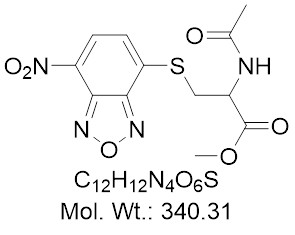
Chemical Name: Methyl 2-(acetylamino)-3-[(7-nitro-2,1,3-benzoxadiazol-4-yl)sulfanyl]propanoate
983 Items
Molarity Calculation Cart®
HOW TO ORDER
Quantity Discount Table - Order More To Get More Price Discount
| Quantity | mg | Unit Price ($/mg or $/Unit) | Final Price |
|---|---|---|---|
| 1 | 5 | $31.45 | Total: $157.25 |
| 1 | 10 | $26.64 | Total: $266.40 |
| 1 | 25 | $22.57 | Total: $564.25 |
| 1 | 50 | $19.24 | Total: $962.00 |
| 1 | 100 | $16.65 | Total: $1,665.00 |
Data sheet
| Molecular Formula | C12H12N4O6S |
| Molecular Weight | 340.31 |
| CAS Numbers | 375826-84-9 |
| Storage Condition | 0°C (short term), -20°C (long term), desiccated |
| Solubility | DMSO |
| Purity | 98% by HPLC |
| Synonym | CN-009543V; CN 009543V; CN009543V |
| IUPAC/Chemical Name | Methyl 2-(acetylamino)-3-[(7-nitro-2,1,3-benzoxadiazol-4-yl)sulfanyl]propanoate |
| InChl Key | RNWHWLQISXPJOJ-UHFFFAOYSA-N |
| InChl Code | InChI=1S/C12H12N4O6S/c1-6(17)13-7(12(18)21-2)5-23-9-4-3-8(16(19)20)10-11(9)15-22-14-10/h3-4,7H,5H2,1-2H3,(H,13,17) |
| SMILES Code | O=C(OC)C(NC(C)=O)CSC1=CC=C([N+]([O-])=O)C2=NON=C21 |
More info
Novel enhancer of tyrosine phosphorylation of EGFR via downstream signaling pathways
What is CN009543V
CN009543V is a small molecule with CAS number 375826-84-9, molecular formula C₁₂H₁₂N₄O₆S, molecular weight ~340.31.
It is used for research use only (not approved for human or veterinary use).
According to multiple catalogues, its described activity is as an enhancer of tyrosine phosphorylation of the epidermal growth factor receptor (EGFR) via downstream signaling pathways.
Mechanism / Functionality
Here are the key functional/mechanistic features:
The compound rapidly enters cells (because it has sufficient lipophilicity) and triggers an increase in intracellular hydrogen peroxide (H₂O₂). Nature+1
This ROS (reactive oxygen species) generation leads to the inhibition of protein tyrosine phosphatases (for example PTP-1B) and activation of the EGFR (via increased tyrosine phosphorylation at key sites such as Tyr1068 & Tyr1173). Nature+1
More specifically:
In cell-based assays (breast cancer cells over-expressing EGFR), exposure to CN009543V → increased EGFR phosphorylation, increased ROS, SOD1 dimer formation. Nature+1
Thus, in simplest terms: CN009543V acts as a chemical activator of EGFR signaling by promoting an intracellular oxidative event that triggers receptor phosphorylation.
Important Considerations / Caveats
Because its mechanism depends on ROS and redox cycling, it has the potential for cytotoxicity or off-target redox effects (not just simple “agonist” behavior). Indeed the literature notes toxicity in certain cell lines. Nature
The “activation” of EGFR is ligand-independent in that the compound bypasses the normal receptor ligand (EGF) mechanism, instead triggering via ROS. That means the effects may differ from physiological activation. Nature
The compound as listed is for research only — not therapeutic, not for in vivo human use without extensive validation. Catalogues emphasize “For research use only”. T
Because of its redox/reactive nature, it might have pleiotropic effects beyond EGFR (i.e., general oxidative stress, binding to other proteins, etc). This must be considered in experiments.
Practical Research Usage
When designing experiments with CN009543V, ensure you include oxidative stress controls (antioxidants, ROS scavengers) to validate that the mechanism is ROS-mediated. The literature used PEG-catalase, NAC, thioglycerol to modulate the effect. Nature
Because the compound increases EGFR phosphorylation, it could be useful to probe downstream EGFR signaling pathways (e.g., MAPK/ERK, PI3K/AKT) in cells that express EGFR.
Controls should include appropriate vehicle, EGFR ligand (EGF) stimulation, EGFR inhibitors (to confirm specificity) and ROS inhibitors.
Dose/timing: the literature showed fairly rapid effects (minutes scale) on phosphorylation/ROS generation. For example ~15 min exposure in MDA MB468 cells. Nature
Note solubility/storage: It is reported to be soluble in DMSO; recommended storage −20 °C or lower.
Customers who bought this product also bought:
-
$37.00
-
$16.00