
No products
Product successfully added to your shopping cart
There are 0 items in your cart. There is 1 item in your cart.
Kinase Inhibitors
- Protein Control Ligand
- Pathway Inhibitors
- Enzyme Inhibitors
- Kinase Inhibitors
- Protease
- Synthase
- p18
- p38
- p53
- p70
- p90
- Peptidase
- Carboxyl and Decarboxylases
- Ceramide Turnover Enzymes
- Chromatin Modifying Enzymes
- Cyclic Nucleotide Turnover Enzymes
- Glycerophospholipid Turnover Enzymes
- Hydroxylases
- Ubiquitin-Activating Enzyme
- Adenosine Deaminase
- Clathrin
- Nuclease
- p68
- ACE
- COX
- DHFR
- Neprilysin
- NF-κB
- RAF
- RAS
- Reductase
- ROR
- Topoisomerase
- Transferase
- Protein Inhibitors
- Transporter Inhibitors
- Cell Inhibition
- Synthase
- Receptor Tyrosine Phosphatases (RTP)
- AChE
- Peptidase
- Autophagy
- Toll-Like Receptor (TLR)
- Enzyme Inhibitors
- Function Modulators
- Activators
- G Protein-Coupled Receptor Ligands
- 5HT Receptors
- Adrenoceptor
- Angiotensin Receptor
- Cannabinoid Receptors
- CCK Receptors
- DA Receptors
- EAA Receptors
- Ghrelin Receptors
- GABA Receptors
- Histamine Receptors
- Leukotriene Receptors
- Metabotropic Glutamate Receptors
- Motilin Receptors
- Muscarinic Receptor
- Neuropeptide Receptors
- Opioid Receptors
- Orexin Receptors
- Orphan Receptors
- Prostanoid Receptors
- Proteinase-Activated Receptors
- Purinergic Receptors
- Ryanodine receptor
- Sigma Receptors
- Thrombin Receptor
- Vaniloid Receptor
- VIP and PACAP Receptors
- Neurotensin Receptors
- Urotensin Receptor
- Imidazoline receptor
- SMO Receptors
- Apelin Receptor
- β-arrestin/β2-adaptin
- KDM4
- Glucocorticoid Receptor
- Laminin Receptor
- AHR
- Amylin Receptor
- Bombesin Receptor
- Bradykinin Receptor
- CFTR
- CGRP Receptor
- CRFR
- Endothelin Receptor
- Ephrin Receptor
- Farnesoid X receptor (FXR)
- Glucagon Receptor
- Nuclear Receptor Ligands
- GDNF Receptors
- TNF Receptors
- Transcription Factors
- Chemokines
- Cytokine Receptors
- Biomarkers and Buffer Solutions
- Molecular Probes
- Stem Cell Research
- Alzheimer's Disease
- Apoptosis
- Cancer Research
- Epigenetics
- Metabolites
- PET/SPECT Imaging Precursors
- Customized Screening Library
- Ultra Pure Pharmacological Standard
- Tissue Microarray (TMA)
- Proteins and Antibodies
- Primary Cells
- ELISA KIT
- Natural Products
- Lab Equipments
- Humanized Mice for PDX Platform
- Rare Chemicals
- Custom Synthesis
- Antibacterial
- Antifungal
- Antioxidant
- Antiviral
- Molecular Glues
- PROTAC Linker
- SARS-CoV
 View larger
 RIm13
AOB13411
CAS: 2375075-75-3
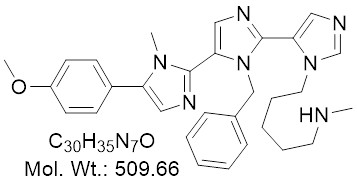
Chemical Name: 5-(3'-Benzyl-5-(4-methoxyphenyl)-1-methyl-1H,3'H,3''H-[2,4':2',4''-terimidazol]-3''-yl)-N-methylpentan-1-amine
2000 Items
Molarity Calculation Cart®
HOW TO ORDER
Quantity Discount Table - Order More To Get More Price Discount
| Quantity (mg or Unit) | Unit Price ($/mg or $/Unit) | Final Price |
|---|---|---|
| 5 | $41.65 | Total: $208.25 |
| 10 | $35.28 | Total: $352.80 |
| 25 | $29.89 | Total: $747.25 |
| 50 | $25.48 | Total: $1,274.00 |
| 100 | $22.05 | Total: $2,205.00 |
Data sheet
| Molecular Formula | C30H35N7O |
| Molecular Weight | 509.66 |
| CAS Numbers | 2375075-75-3 |
| Storage Condition | 0°C (short term), -20°C (long term), desiccated |
| Solubility | DMSO and Alcohol |
| Purity | 98% by HPLC |
| IUPAC/Chemical Name | 5-(3'-Benzyl-5-(4-methoxyphenyl)-1-methyl-1H,3'H,3''H-[2,4':2',4''-terimidazol]-3''-yl)-N-methylpentan-1-amine |
| SMILES Code | CXHJQCQAKUNWMJ-UHFFFAOYSA-N |
More info
Novel potent inhibitor of Proprotein convertase subtilisin/kexin 9 (PCSK9), targeting the PCSK9/LDLR protein-protein interaction
Mechanism of action
RIm13 is described as a small-molecule drug whose main therapeutic target is the enzyme/protein PCSK9 (proprotein convertase subtilisin/kexin type 9). Synapse+1
By inhibiting PCSK9, the compound aims to reduce the levels of low-density lipoprotein cholesterol (LDL-C). The rationale: PCSK9 normally binds to LDL receptors on liver cells and leads to their degradation, thus fewer LDL receptors means less clearance of LDL-C from the bloodstream. Inhibiting PCSK9 therefore increases LDL receptor availability and promotes LDL-C clearance. DOAJ+1
Development status & functional implications
RIm13 is currently in the pre-clinical stage (i.e., not yet in approved clinical use). Synapse+1
Its intended therapeutic indication is for hypercholesterolemia (elevated LDL cholesterol) via PCSK9 inhibition. Synapse
Because it is still in early development, detailed functional data in humans (pharmacodynamics, pharmacokinetics, safety profile) are not publicly available.
The general functionality (from the class of PCSK9 inhibitors) suggests that if successful, RIm13 might:
Lower LDL-C levels significantly (based on what is known from PCSK9 inhibitors generally).
Potentially reduce risk of cardiovascular events associated with high LDL-C (though this depends on clinical outcomes).