
Cart 0 Product Products (empty)
No products
Free shipping! Shipping
$0.00 Total
Product successfully added to your shopping cart
Quantity
Unit
Total
There are 0 items in your cart. There is 1 item in your cart.
Total products (tax excl.)
Total shipping (tax excl.) Free shipping!
Total (tax excl.)
Metabolites
- Protein Control Ligand
- Pathway Inhibitors
- Enzyme Inhibitors
- Kinase Inhibitors
- Protease
- Synthase
- p18
- p38
- p53
- p70
- p90
- Peptidase
- Carboxyl and Decarboxylases
- Ceramide Turnover Enzymes
- Chromatin Modifying Enzymes
- Cyclic Nucleotide Turnover Enzymes
- Glycerophospholipid Turnover Enzymes
- Hydroxylases
- Ubiquitin-Activating Enzyme
- Adenosine Deaminase
- Clathrin
- Nuclease
- p68
- ACE
- COX
- DHFR
- Neprilysin
- NF-κB
- RAF
- RAS
- Reductase
- ROR
- Topoisomerase
- Transferase
- Protein Inhibitors
- Transporter Inhibitors
- Cell Inhibition
- Synthase
- Receptor Tyrosine Phosphatases (RTP)
- AChE
- Peptidase
- Autophagy
- Toll-Like Receptor (TLR)
- Enzyme Inhibitors
- Function Modulators
- Activators
- G Protein-Coupled Receptor Ligands
- 5HT Receptors
- Adrenoceptor
- Angiotensin Receptor
- Cannabinoid Receptors
- CCK Receptors
- DA Receptors
- EAA Receptors
- Ghrelin Receptors
- GABA Receptors
- Histamine Receptors
- Leukotriene Receptors
- Metabotropic Glutamate Receptors
- Motilin Receptors
- Muscarinic Receptor
- Neuropeptide Receptors
- Opioid Receptors
- Orexin Receptors
- Orphan Receptors
- Prostanoid Receptors
- Proteinase-Activated Receptors
- Purinergic Receptors
- Ryanodine receptor
- Sigma Receptors
- Thrombin Receptor
- Vaniloid Receptor
- VIP and PACAP Receptors
- Neurotensin Receptors
- Urotensin Receptor
- Imidazoline receptor
- SMO Receptors
- Apelin Receptor
- β-arrestin/β2-adaptin
- KDM4
- Glucocorticoid Receptor
- Laminin Receptor
- AHR
- Amylin Receptor
- Bombesin Receptor
- Bradykinin Receptor
- CFTR
- CGRP Receptor
- CRFR
- Endothelin Receptor
- Ephrin Receptor
- Farnesoid X receptor (FXR)
- Glucagon Receptor
- Nuclear Receptor Ligands
- GDNF Receptors
- TNF Receptors
- Transcription Factors
- Chemokines
- Cytokine Receptors
- Biomarkers and Buffer Solutions
- Molecular Probes
- Stem Cell Research
- Alzheimer's Disease
- Apoptosis
- Cancer Research
- Epigenetics
- Metabolites
- PET/SPECT Imaging Precursors
- Customized Screening Library
- Ultra Pure Pharmacological Standard
- Tissue Microarray (TMA)
- Proteins and Antibodies
- Primary Cells
- ELISA KIT
- Natural Products
- Lab Equipments
- Humanized Mice for PDX Platform
- Rare Chemicals
- Custom Synthesis
- Antibacterial
- Antifungal
- Antioxidant
- Antiviral
- Molecular Glues
- PROTAC Linker
- SARS-CoV
 View larger
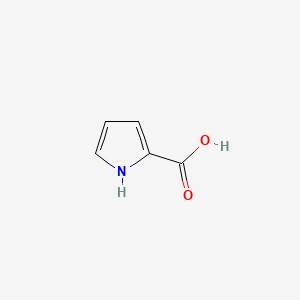
 Pyrrole-2-carboxylic acid
AT4716
CAS 634-97-9
1000 Items
Molarity Calculation Cart®
HOW TO ORDER
Data sheet
| Molecular Formula | C5H5NO2 |
| Molecular Weight | 111.1 |
| CAS Numbers | 634-97-9 |
| Storage Condition | 0C Short Term, -20C Long Term |
| Solubility | DMSO |
| Purity | 98% by HPLC |
| SMILES Code | OC(=O)C1=CC=CN1 |
| References | He XX, et al. Pelopuradazole, a new imidazole derivative alkaloid from the marine bacteria Pelomonas puraquae sp. nov. Nat Prod Res. 2014;28[9] 680-2. |
More info
Pyrrole-2-carboxylic acid (Minaline) was first identified as a degradation product of sialic acids, then as a derivative of the oxidation of the D-hydroxyproline isomers by mammalian D-amino acid oxidase. The latter relationship results from the lability of the direct oxidation product, A'-pyrroline-4-hydroxy-2-carboxylic acid, which loses water spontaneously to form the pyrrole. A similar reaction is catalyzed by the more specific allohydroxy-D-proline oxidase of Pseudomonas. In whole animal observations, pyrrole-2-carboxylate (PCA) ' was identified in rat or human urine after administration of the D-isomers of hydroxyproline, a finding ascribable to the action of D-amino acid oxidase. Urinary excretion of N-(pyrrole-2-carboxyl) glycine has been reported in a 5-year-old affected with type II hyperprolinemia; The child has mild developmental delay, recurrent seizures of the grand mal type and EEG alterations.