
No products
Product successfully added to your shopping cart
There are 0 items in your cart. There is 1 item in your cart.
Muscarinic Receptor
- Protein Control Ligand
- Pathway Inhibitors
- Enzyme Inhibitors
- Kinase Inhibitors
- Protease
- Synthase
- p18
- p38
- p53
- p70
- p90
- Peptidase
- Carboxyl and Decarboxylases
- Ceramide Turnover Enzymes
- Chromatin Modifying Enzymes
- Cyclic Nucleotide Turnover Enzymes
- Glycerophospholipid Turnover Enzymes
- Hydroxylases
- Ubiquitin-Activating Enzyme
- Adenosine Deaminase
- Clathrin
- Nuclease
- p68
- ACE
- COX
- DHFR
- Neprilysin
- NF-κB
- RAF
- RAS
- Reductase
- ROR
- Topoisomerase
- Transferase
- Protein Inhibitors
- Transporter Inhibitors
- Cell Inhibition
- Synthase
- Receptor Tyrosine Phosphatases (RTP)
- AChE
- Peptidase
- Autophagy
- Toll-Like Receptor (TLR)
- Enzyme Inhibitors
- Function Modulators
- Activators
- G Protein-Coupled Receptor Ligands
- 5HT Receptors
- Adrenoceptor
- Angiotensin Receptor
- Cannabinoid Receptors
- CCK Receptors
- DA Receptors
- EAA Receptors
- Ghrelin Receptors
- GABA Receptors
- Histamine Receptors
- Leukotriene Receptors
- Metabotropic Glutamate Receptors
- Motilin Receptors
- Muscarinic Receptor
- Neuropeptide Receptors
- Opioid Receptors
- Orexin Receptors
- Orphan Receptors
- Prostanoid Receptors
- Proteinase-Activated Receptors
- Purinergic Receptors
- Ryanodine receptor
- Sigma Receptors
- Thrombin Receptor
- Vaniloid Receptor
- VIP and PACAP Receptors
- Neurotensin Receptors
- Urotensin Receptor
- Imidazoline receptor
- SMO Receptors
- Apelin Receptor
- β-arrestin/β2-adaptin
- KDM4
- Glucocorticoid Receptor
- Laminin Receptor
- AHR
- Amylin Receptor
- Bombesin Receptor
- Bradykinin Receptor
- CFTR
- CGRP Receptor
- CRFR
- Endothelin Receptor
- Ephrin Receptor
- Farnesoid X receptor (FXR)
- Glucagon Receptor
- Nuclear Receptor Ligands
- GDNF Receptors
- TNF Receptors
- Transcription Factors
- Chemokines
- Cytokine Receptors
- Biomarkers and Buffer Solutions
- Molecular Probes
- Stem Cell Research
- Alzheimer's Disease
- Apoptosis
- Cancer Research
- Epigenetics
- Metabolites
- PET/SPECT Imaging Precursors
- Customized Screening Library
- Ultra Pure Pharmacological Standard
- Tissue Microarray (TMA)
- Proteins and Antibodies
- Primary Cells
- ELISA KIT
- Natural Products
- Lab Equipments
- Humanized Mice for PDX Platform
- Rare Chemicals
- Custom Synthesis
- Antibacterial
- Antifungal
- Antioxidant
- Antiviral
- Molecular Glues
- PROTAC Linker
- SARS-CoV
 View larger
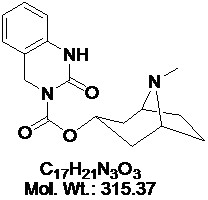
 DAU5884
AOB4301
CAS No: 131780-47-7
Chemical Name: 2-Oxo-1,4-dihydro-2H-quinazoline-3-carboxylic acid 8-methyl-8-aza-bicyclo[3.2.1]oct-3-yl ester
489 Items
Molarity Calculation Cart®
HOW TO ORDER
Quantity Discount Table - Order More To Get More Price Discount
| Quantity | mg | Unit Price ($/mg or $/Unit) | Final Price |
|---|---|---|---|
| 1 | 5 | $11.05 | Total: $55.25 |
| 1 | 10 | $9.36 | Total: $93.60 |
| 1 | 25 | $7.93 | Total: $198.25 |
| 1 | 50 | $6.76 | Total: $338.00 |
| 1 | 100 | $5.85 | Total: $585.00 |
Data sheet
| Molecular Formula | C17H21N3O3 |
| Molecular Weight | 315.37 |
| CAS Numbers | 131780-47-7 |
| Storage Condition | 0C Short Term -20C Long Term |
| Solubility | DMSO |
| Purity | 98% by HPLC |
More info
Selective muscarinic M3 receptor antagonist
DAU 5884 is a synthetic small molecule that acts as an antagonist of the muscarinic acetylcholine receptor subtype M₃ (mAChR M₃).
Its chemical formula (for the hydrochloride form) is C₁₇H₂₂ClN₃O₃, molecular weight ~ 351.8 Da.
It has good purity in commercially sold research reagent form (≥ 98–99%) and is described for research use only.
Mechanism / Biological Activity
As an M₃ receptor antagonist, DAU 5884 binds to the M₃ muscarinic receptor and prevents activation by the natural ligand (acetylcholine) or agonists.
The M₃ receptor is Gq‑coupled and involved in various functions such as smooth muscle contraction, glandular secretion, and certain CNS functions.
In functional assays:
It inhibits methacholine‑dependent effects (methacholine is a muscarinic agonist) on contractility and cell proliferation in bovine tracheal smooth muscle.
It has been noted to exhibit IC₅₀ values in the range of ~ 8 to ~ 131 nM in competitive binding assays against [^3H]NMS (a muscarinic antagonist radioligand) at M₃ receptors.
Use in Research
Because it is selective for the M₃ subtype, DAU 5884 is used in research to dissect the role of M₃ receptors in physiological and pathophysiological settings (e.g., airway smooth muscle contraction, proliferative responses, cholinergic regulation).
Example: It has been used to study how M₃ receptor activation contributes to airway smooth muscle growth and contraction in models of respiratory disease. ERS Publications+1
Another example: It has been used in neuroscience research (e.g., in studies of cholinergic synapse degeneration and cognitive impairment) to understand the influence of muscarinic signalling.
Important Considerations
Despite being labelled as “selective”, binding to other muscarinic subtypes (or off‑target effects) is always a possibility depending on concentration, cell type, species, etc. (One source notes “discriminates between M4 and M2” in another context)
As with many pharmacological antagonists: the context of use (in vitro vs in vivo), dosing, receptor expression levels, species differences, and presence of endogenous ligand matter a lot.
Always ensure you have the Certificate of Analysis (CoA) and check the lot‐specific purity.
Since it is a research reagent, not approved for clinical or diagnostic use, ensure it is handled according to institutional safety/ethics policies.
Customers who bought this product also bought:
-
$29.00
-
$12.00
-
$29.50
-
$15.00
-
$10.00
-
$37.00