
No products
Product successfully added to your shopping cart
There are 0 items in your cart. There is 1 item in your cart.
G Protein-Coupled Receptor Ligands
- Protein Control Ligand
- Pathway Inhibitors
- Enzyme Inhibitors
- Kinase Inhibitors
- Protease
- Synthase
- p18
- p38
- p53
- p70
- p90
- Peptidase
- Carboxyl and Decarboxylases
- Ceramide Turnover Enzymes
- Chromatin Modifying Enzymes
- Cyclic Nucleotide Turnover Enzymes
- Glycerophospholipid Turnover Enzymes
- Hydroxylases
- Ubiquitin-Activating Enzyme
- Adenosine Deaminase
- Clathrin
- Nuclease
- p68
- ACE
- COX
- DHFR
- Neprilysin
- NF-κB
- RAF
- RAS
- Reductase
- ROR
- Topoisomerase
- Transferase
- Protein Inhibitors
- Transporter Inhibitors
- Cell Inhibition
- Synthase
- Receptor Tyrosine Phosphatases (RTP)
- AChE
- Peptidase
- Autophagy
- Toll-Like Receptor (TLR)
- Enzyme Inhibitors
- Function Modulators
- Activators
- G Protein-Coupled Receptor Ligands
- 5HT Receptors
- Adrenoceptor
- Angiotensin Receptor
- Cannabinoid Receptors
- CCK Receptors
- DA Receptors
- EAA Receptors
- Ghrelin Receptors
- GABA Receptors
- Histamine Receptors
- Leukotriene Receptors
- Metabotropic Glutamate Receptors
- Motilin Receptors
- Muscarinic Receptor
- Neuropeptide Receptors
- Opioid Receptors
- Orexin Receptors
- Orphan Receptors
- Prostanoid Receptors
- Proteinase-Activated Receptors
- Purinergic Receptors
- Ryanodine receptor
- Sigma Receptors
- Thrombin Receptor
- Vaniloid Receptor
- VIP and PACAP Receptors
- Neurotensin Receptors
- Urotensin Receptor
- Imidazoline receptor
- SMO Receptors
- Apelin Receptor
- β-arrestin/β2-adaptin
- KDM4
- Glucocorticoid Receptor
- Laminin Receptor
- AHR
- Amylin Receptor
- Bombesin Receptor
- Bradykinin Receptor
- CFTR
- CGRP Receptor
- CRFR
- Endothelin Receptor
- Ephrin Receptor
- Farnesoid X receptor (FXR)
- Glucagon Receptor
- Nuclear Receptor Ligands
- GDNF Receptors
- TNF Receptors
- Transcription Factors
- Chemokines
- Cytokine Receptors
- Biomarkers and Buffer Solutions
- Molecular Probes
- Stem Cell Research
- Alzheimer's Disease
- Apoptosis
- Cancer Research
- Epigenetics
- Metabolites
- PET/SPECT Imaging Precursors
- Customized Screening Library
- Ultra Pure Pharmacological Standard
- Tissue Microarray (TMA)
- Proteins and Antibodies
- Primary Cells
- ELISA KIT
- Natural Products
- Lab Equipments
- Humanized Mice for PDX Platform
- Rare Chemicals
- Custom Synthesis
- Antibacterial
- Antifungal
- Antioxidant
- Antiviral
- Molecular Glues
- PROTAC Linker
- SARS-CoV
 View larger
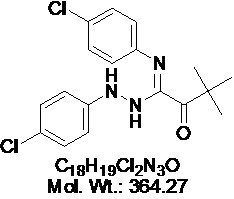
 TY-52156
AOB5160
CAS No: 934369-14-9
Chemical Name: TY52156; N-(4-Chlorophenyl)-3,3-dimethyl-2-oxobutanimidic 2-(4-chlorophenyl) hydrazide
497 Items
Molarity Calculation Cart®
HOW TO ORDER
Quantity Discount Table - Order More To Get More Price Discount
| Quantity | 10 mg | Unit Price ($/mg or $/Unit) | Final Price |
|---|---|---|---|
| 1 | 5 | $33.15 | Total: $165.75 |
| 1 | 10 | $28.08 | Total: $280.80 |
| 1 | 25 | $23.79 | Total: $594.75 |
| 1 | 50 | $20.28 | Total: $1,014.00 |
| 1 | 100 | $17.55 | Total: $1,755.00 |
Data sheet
| Molecular Formula | C18H19Cl2N3Q |
| Molecular Weight | 364.27 |
| CAS Numbers | 934369-14-9 |
| Storage Condition | 0°C (short term), -20°C (long term), desiccated |
| Solubility | DMSO |
| Purity | 98% by HPLC |
More info
Novel S1P3 receptor antagonist
Binding & Affinity
TY-52156 is a selective antagonist of the S1P₃ (sphingosine-1-phosphate receptor subtype 3).
It has a Ki of about 110 nM for S1P₃.
It inhibits S1P-induced intracellular calcium release in HUVEC (human endothelial) cells.
Effective Doses / Pharmacodynamics in Animals
Orally, TY-52156 at 10 mg/kg and 30 mg/kg doses suppresses S1P₃-mediated bradycardia induced by FTY-720 in vivo (in animals).
In the leukocyte-rolling / endothelial P-selectin mobilization study in mice: TY-52156 was given intraperitoneally (i.p.) at 1.25 mg/kg 30 minutes before the experiment. This dose produced a “dramatic reduction in leukocyte rolling.” ResearchGate
Side Effects or Observed Physiological Effects
The ability of TY-52156 to suppress FTY-720-induced bradycardia suggests it can mitigate one of the known side-effects of FTY-720 (which activates S1P₃ among others) by blocking S1P₃. ResearchGate+2
Evidence from vascular studies: TY-52156 blocks S1P-induced decrease in coronary flow (a vasoconstrictive effect) in isolated perfused rat hearts, and blocks Rho activation and calcium signalling in coronary artery smooth muscle cells. In those studies, TY-52156 reduces vasoconstriction mediated by S1P₃. PubMed+1
Limitations / What’s Unknown
Detailed pharmacokinetic parameters (e.g. plasma half-life, tissue distribution, metabolic rate) are less well documented in the literature.
Information on chronic dosing side-effects (beyond acute bradycardia or vascular effects) is sparse.
Data in larger mammals or toxicity studies are not widely published (to my knowledge).
No human clinical data (safety, tolerability, side effects) is currently available.
Customers who bought this product also bought:
-
$15.00
-
$49.00
-
$10.00
-
$21.00
-
$15.00
-
$49.00