
No products
Product successfully added to your shopping cart
There are 0 items in your cart. There is 1 item in your cart.
Proteins and Enzymes
- Protein Control Ligand
- Pathway Inhibitors
- Enzyme Inhibitors
- Kinase Inhibitors
- Protease
- Synthase
- p18
- p38
- p53
- p70
- p90
- Peptidase
- Carboxyl and Decarboxylases
- Ceramide Turnover Enzymes
- Chromatin Modifying Enzymes
- Cyclic Nucleotide Turnover Enzymes
- Glycerophospholipid Turnover Enzymes
- Hydroxylases
- Ubiquitin-Activating Enzyme
- Adenosine Deaminase
- Clathrin
- Nuclease
- p68
- ACE
- COX
- DHFR
- Neprilysin
- NF-κB
- RAF
- RAS
- Reductase
- ROR
- Topoisomerase
- Transferase
- Protein Inhibitors
- Transporter Inhibitors
- Cell Inhibition
- Synthase
- Receptor Tyrosine Phosphatases (RTP)
- AChE
- Peptidase
- Autophagy
- Toll-Like Receptor (TLR)
- Enzyme Inhibitors
- Function Modulators
- Activators
- G Protein-Coupled Receptor Ligands
- 5HT Receptors
- Adrenoceptor
- Angiotensin Receptor
- Cannabinoid Receptors
- CCK Receptors
- DA Receptors
- EAA Receptors
- Ghrelin Receptors
- GABA Receptors
- Histamine Receptors
- Leukotriene Receptors
- Metabotropic Glutamate Receptors
- Motilin Receptors
- Muscarinic Receptor
- Neuropeptide Receptors
- Opioid Receptors
- Orexin Receptors
- Orphan Receptors
- Prostanoid Receptors
- Proteinase-Activated Receptors
- Purinergic Receptors
- Ryanodine receptor
- Sigma Receptors
- Thrombin Receptor
- Vaniloid Receptor
- VIP and PACAP Receptors
- Neurotensin Receptors
- Urotensin Receptor
- Imidazoline receptor
- SMO Receptors
- Apelin Receptor
- β-arrestin/β2-adaptin
- KDM4
- Glucocorticoid Receptor
- Laminin Receptor
- AHR
- Amylin Receptor
- Bombesin Receptor
- Bradykinin Receptor
- CFTR
- CGRP Receptor
- CRFR
- Endothelin Receptor
- Ephrin Receptor
- Farnesoid X receptor (FXR)
- Glucagon Receptor
- Nuclear Receptor Ligands
- GDNF Receptors
- TNF Receptors
- Transcription Factors
- Chemokines
- Cytokine Receptors
- Biomarkers and Buffer Solutions
- Molecular Probes
- Stem Cell Research
- Alzheimer's Disease
- Apoptosis
- Cancer Research
- Epigenetics
- Metabolites
- PET/SPECT Imaging Precursors
- Customized Screening Library
- Ultra Pure Pharmacological Standard
- Tissue Microarray (TMA)
- Proteins and Antibodies
- Primary Cells
- ELISA KIT
- Natural Products
- Lab Equipments
- Humanized Mice for PDX Platform
- Rare Chemicals
- Custom Synthesis
- Antibacterial
- Antifungal
- Antioxidant
- Antiviral
- Molecular Glues
- PROTAC Linker
- SARS-CoV
 View larger
Human TNF-alpha / TNFA Protein
10602-HNAE
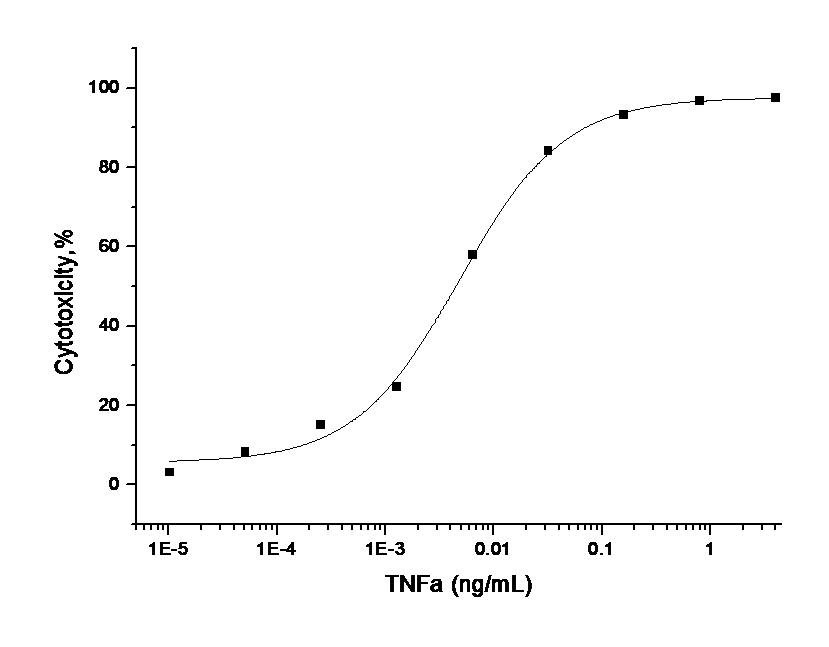
Activity: Measured in a cytotoxicity assay using L929 mouse fibrosarcoma cells in the presence of the metabolic inhibitor actinomycin D.
The ED50 for this effect is typically 5-50 pg/mL
1000 Items
Please ask for quote for unit smaller than 1 mg
Molarity Calculation Cart®
HOW TO ORDER
Data sheet
| Molecular Weight | The recombinant human TNF-α consists of 158 amino acids and has a predicted molecular mass of 17.4 kDa which is also estimated by SDS-PAGE. |
| Storage Condition | Samples are stable for up to twelve months from date of receipt at -70℃ Store it under sterile conditions at -20℃ to -80℃. It is recommended that the protein be aliquoted for optimal storage. Avoid repeated freeze-thaw cycles. |
| Purity | 95 % as determined by SDS-PAGE |
More info
Protein Construction: A DNA sequence encoding the human TNF-α soluble form (NP_000585.2) (Val 77-Leu 233) was expressed, with an initial Met at the N-terminus.
Formulation: Lyophilized from sterile PBS, pH 7.41. Normally 5 % - 8 % trehalose, mannitol and 0.01% Tween80 are added as protectants before lyophilization. Specific concentrations are included in the hardcopy of COA.2. Please contact us for any concerns or special requirements.Please refer to the specific buffer information in the hard copy of CoA.
Reconstitution: A hardcopy of COA with reconstitution instruction is sent along with the products. Please refer to it for detailed information.
TNF-alpha Background Information : Tumor necrosis factor alpha (TNF-alpha), also known as TNF, TNFA or TNFSF2, is the prototypic cytokine of the TNF superfamily, and is a multifunctional molecule involved in the regulation of a wide spectrum of biological processes including cell proliferation, differentiation, apoptosis, lipid metabolism, and coagulation. Two receptors, TNF-R1 (TNF receptor type 1; CD12a; p55/6) and TNF-R2 (TNF receptor type 2; CD12b; p75/8), bind to TNF-alpha. TNF-alpha protein is produced mainly by macrophages, and large amounts of this cytokine are released in response to lipopolysaccharide, other bacterial products, and Interleukin-1 (IL-1). TNF-alpha is involved in fighting against the tumorigenesis, thus, is regarded as a molecular insight in cancer treatment.
References:
- Hector J, et al. (2007) TNF-alpha alters visfatin and adiponectin levels in human fat. Horm Metab Res. 39(4): 250-5.
- Berthold-Losleben M, et al. (2008) The TNF-alpha System: Functional Aspects in Depression, Narcolepsy and Psychopharmacology. Curr Neuropharmacol. 6(3): 193-202.