
No products
Product successfully added to your shopping cart
There are 0 items in your cart. There is 1 item in your cart.
Adrenoceptor
- Protein Control Ligand
- Pathway Inhibitors
- Enzyme Inhibitors
- Kinase Inhibitors
- Protease
- Synthase
- p18
- p38
- p53
- p70
- p90
- Peptidase
- Carboxyl and Decarboxylases
- Ceramide Turnover Enzymes
- Chromatin Modifying Enzymes
- Cyclic Nucleotide Turnover Enzymes
- Glycerophospholipid Turnover Enzymes
- Hydroxylases
- Ubiquitin-Activating Enzyme
- Adenosine Deaminase
- Clathrin
- Nuclease
- p68
- ACE
- COX
- DHFR
- Neprilysin
- NF-κB
- RAF
- RAS
- Reductase
- ROR
- Topoisomerase
- Transferase
- Protein Inhibitors
- Transporter Inhibitors
- Cell Inhibition
- Synthase
- Receptor Tyrosine Phosphatases (RTP)
- AChE
- Peptidase
- Autophagy
- Toll-Like Receptor (TLR)
- Enzyme Inhibitors
- Function Modulators
- Activators
- G Protein-Coupled Receptor Ligands
- 5HT Receptors
- Adrenoceptor
- Angiotensin Receptor
- Cannabinoid Receptors
- CCK Receptors
- DA Receptors
- EAA Receptors
- Ghrelin Receptors
- GABA Receptors
- Histamine Receptors
- Leukotriene Receptors
- Metabotropic Glutamate Receptors
- Motilin Receptors
- Muscarinic Receptor
- Neuropeptide Receptors
- Opioid Receptors
- Orexin Receptors
- Orphan Receptors
- Prostanoid Receptors
- Proteinase-Activated Receptors
- Purinergic Receptors
- Ryanodine receptor
- Sigma Receptors
- Thrombin Receptor
- Vaniloid Receptor
- VIP and PACAP Receptors
- Neurotensin Receptors
- Urotensin Receptor
- Imidazoline receptor
- SMO Receptors
- Apelin Receptor
- β-arrestin/β2-adaptin
- KDM4
- Glucocorticoid Receptor
- Laminin Receptor
- AHR
- Amylin Receptor
- Bombesin Receptor
- Bradykinin Receptor
- CFTR
- CGRP Receptor
- CRFR
- Endothelin Receptor
- Ephrin Receptor
- Farnesoid X receptor (FXR)
- Glucagon Receptor
- Nuclear Receptor Ligands
- GDNF Receptors
- TNF Receptors
- Transcription Factors
- Chemokines
- Cytokine Receptors
- Biomarkers and Buffer Solutions
- Molecular Probes
- Stem Cell Research
- Alzheimer's Disease
- Apoptosis
- Cancer Research
- Epigenetics
- Metabolites
- PET/SPECT Imaging Precursors
- Customized Screening Library
- Ultra Pure Pharmacological Standard
- Tissue Microarray (TMA)
- Proteins and Antibodies
- Primary Cells
- ELISA KIT
- Natural Products
- Lab Equipments
- Humanized Mice for PDX Platform
- Rare Chemicals
- Custom Synthesis
- Antibacterial
- Antifungal
- Antioxidant
- Antiviral
- Molecular Glues
- PROTAC Linker
- SARS-CoV
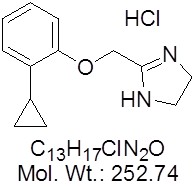 View larger
 Cirazoline hydrochloride
AOB5903
CAS No:40600-13-3
Chemical Name: 2-[(2-Cyclopropylphenoxy)methyl]-4,5-dihydro-1H-imidazole hydrochlorid
400 Items
Molarity Calculation Cart®
HOW TO ORDER
Quantity Discount Table - Order More To Get More Price Discount
| Quantity | mg | Unit Price ($/mg or $/Unit) | Final Price |
|---|---|---|---|
| 1 | 5 | $17.85 | Total: $89.25 |
| 1 | 10 | $15.12 | Total: $151.20 |
| 1 | 25 | $12.81 | Total: $320.25 |
| 1 | 50 | $10.92 | Total: $546.00 |
| 1 | 100 | $9.45 | Total: $945.00 |
Data sheet
| Molecular Formula | C13H17ClN2O |
| Molecular Weight | 252.74 |
| CAS Numbers | 40600-13-3 |
| Storage Condition | 0°C (short term), -20°C (long term), desiccated |
| Solubility | DMSO |
| Purity | 98% by HPLC |
| IUPAC/Chemical Name | 2-(2-Cyclopropylphenoxymethyl)imidazoline hydrochloride |
| InChl Key | XFRXWLWUUDJHPB-UHFFFAOYSA-N |
| SMILES Code | [H]Cl.C1(COC2=CC=CC=C2C3CC3)=NCCN1 |
| References | 1) Doze VA, et al. alpha(1A)- and alpha(1B)-adrenergic receptors differentially modulate antidepressant-like behaviorin the mouse.Brain Res. 2009 Aug 18;1285:148-57 |
| PubChem ID | 11957512 |
More info
Selective alpha1-adrenoceptor agonist; non-selective imidazoline binding site ligand
What it is
Cirazoline (often used in its hydrochloride salt form) is a synthetic compound used in research settings (not a marketed therapeutic drug) that interacts with the adrenergic (and imidazoline) receptor systems. Wikipedia+3NCATS Inxight Drugs+3
Its chemical description: for example, one source lists it as “2-(2-Cyclopropylphenoxymethyl)imidazoline hydrochloride”.
How it works (mechanism of action)
Cirazoline acts as an agonist at the α₁-adrenergic receptor subtypes: specifically a full agonist at α₁A, and partial agonist at α₁B and α₁D. DrugBank+2IUPHAR/BPS Guide to PHARMACOLOGY+2
It also acts as an antagonist (non-selective) at α₂-adrenergic receptors. PubMed+2NCATS Inxight Drugs+2
Because of these receptor effects, it has been used as a tool compound to study how stimulation of α₁ and blockade of α₂ receptors influence physiological responses (e.g., vascular tone, feeding behavior, memory) in animals. Wikipedia+2PubMed+2
Functional (physiological) effects
Vasoconstriction / blood-pressure effect: By stimulating α₁ receptors (which are often present on vascular smooth muscle), cirazoline can cause constriction of blood vessels and thereby increase blood pressure (in animal studies). DrugBank+1
Impact on feeding / intake: In rats, cirazoline administered into the paraventricular nucleus of the hypothalamus reduced feeding and water intake, presumably via α₁-adrenoceptor activation. DrugBank+1
Cognitive / memory effects: In aged rhesus monkeys, cirazoline impaired spatial working memory in certain tests, which suggests that α₁-adrenergic activation (or imidazoline receptor interaction) in the brain can affect prefrontal‐cortex-dependent functions. PubMed+1
Research / usage context
It is primarily used as a research tool, not as an approved drug for treatment. DrugBank+1
Many of the studies are in animals (rats, monkeys) or in vitro (cell membranes) rather than in humans.
Being able to stimulate α₁A and partially α₁B/α₁D, and also block α₂, makes it useful for dissecting how different adrenergic receptor subtypes contribute to physiological responses.
Limitations & caveats
Because the compound has multiple receptor activities (agonist at some, antagonist at others) and crosses into the brain, its effects can be complex and not purely selective. For example, interfering with memory in animals. PubMed+1
The full safety, pharmacokinetics, metabolism, and human‐clinical profile are either not well characterized for therapeutic use.
As with many experimental compounds, translation from animal studies to human set‐ups is uncertain.
Customers who bought this product also bought:
-
$13.35
-
$37.00
-
$19.00
-
$13.00
-
$122.00
-
$23.00