No products
Product successfully added to your shopping cart
There are 0 items in your cart. There is 1 item in your cart.
Purinergic Receptors
- Protein Control Ligand
- Pathway Inhibitors
- Enzyme Inhibitors
- Kinase Inhibitors
- Protease
- Synthase
- p18
- p38
- p53
- p70
- p90
- Peptidase
- Carboxyl and Decarboxylases
- Ceramide Turnover Enzymes
- Chromatin Modifying Enzymes
- Cyclic Nucleotide Turnover Enzymes
- Glycerophospholipid Turnover Enzymes
- Hydroxylases
- Ubiquitin-Activating Enzyme
- Adenosine Deaminase
- Clathrin
- Nuclease
- p68
- ACE
- COX
- DHFR
- Neprilysin
- NF-κB
- RAF
- RAS
- Reductase
- ROR
- Topoisomerase
- Transferase
- Protein Inhibitors
- Transporter Inhibitors
- Cell Inhibition
- Synthase
- Receptor Tyrosine Phosphatases (RTP)
- AChE
- Peptidase
- Autophagy
- Toll-Like Receptor (TLR)
- Enzyme Inhibitors
- Function Modulators
- Activators
- G Protein-Coupled Receptor Ligands
- 5HT Receptors
- Adrenoceptor
- Angiotensin Receptor
- Cannabinoid Receptors
- CCK Receptors
- DA Receptors
- EAA Receptors
- Ghrelin Receptors
- GABA Receptors
- Histamine Receptors
- Leukotriene Receptors
- Metabotropic Glutamate Receptors
- Motilin Receptors
- Muscarinic Receptor
- Neuropeptide Receptors
- Opioid Receptors
- Orexin Receptors
- Orphan Receptors
- Prostanoid Receptors
- Proteinase-Activated Receptors
- Purinergic Receptors
- Ryanodine receptor
- Sigma Receptors
- Thrombin Receptor
- Vaniloid Receptor
- VIP and PACAP Receptors
- Neurotensin Receptors
- Urotensin Receptor
- Imidazoline receptor
- SMO Receptors
- Apelin Receptor
- β-arrestin/β2-adaptin
- KDM4
- Glucocorticoid Receptor
- Laminin Receptor
- AHR
- Amylin Receptor
- Bombesin Receptor
- Bradykinin Receptor
- CFTR
- CGRP Receptor
- CRFR
- Endothelin Receptor
- Ephrin Receptor
- Farnesoid X receptor (FXR)
- Glucagon Receptor
- Nuclear Receptor Ligands
- GDNF Receptors
- TNF Receptors
- Transcription Factors
- Chemokines
- Cytokine Receptors
- Biomarkers and Buffer Solutions
- Molecular Probes
- Stem Cell Research
- Alzheimer's Disease
- Apoptosis
- Cancer Research
- Epigenetics
- Metabolites
- PET/SPECT Imaging Precursors
- Customized Screening Library
- Ultra Pure Pharmacological Standard
- Tissue Microarray (TMA)
- Proteins and Antibodies
- Primary Cells
- ELISA KIT
- Natural Products
- Lab Equipments
- Humanized Mice for PDX Platform
- Rare Chemicals
- Custom Synthesis
- Antibacterial
- Antifungal
- Antioxidant
- Antiviral
- Molecular Glues
- PROTAC Linker
- SARS-CoV
 View larger
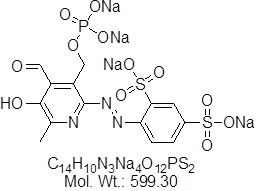
 PPADS tetrasodium salt
AOB5632
CAS: 192575-19-2
Chemical Name: Pyridoxal phosphate-6-azo(benzene-2,4-disulfonic acid) tetrasodium salt; 4-[[4-Formyl-5-hydroxy-6-methyl-3-[(phosphonooxy)methyl]-2-pyridinyl]azo]-1,3-benzenedisulfonic acid tetrasodium salt
Molarity Calculation Cart®
HOW TO ORDER
Quantity Discount Table - Order More To Get More Price Discount
| Quantity | 10 mg | Unit Price ($/mg or $/Unit) | Final Price |
|---|---|---|---|
| 1 | 5 | $38.25 | Total: $191.25 |
| 1 | 10 | $32.40 | Total: $324.00 |
| 1 | 25 | $27.45 | Total: $686.25 |
| 1 | 50 | $23.40 | Total: $1,170.00 |
| 1 | 100 | $20.25 | Total: $2,025.00 |
Data sheet
| Molecular Formula | C14H10N3Na4O12PS2 |
| Molecular Weight | 599.30 |
| CAS Numbers | 192575-19-2 |
| Storage Condition | 0°C (short term), -20°C (long term), desiccated |
| Solubility | DMSO |
| Purity | 98% by HPLC |
| Synonym | PPADS 4Na |
| IUPAC/Chemical Name | Pyridoxalphosphate-6-azophenyl-2',4'-disulfonic acid tetrasodium salt |
| InChl Key | KURWUCJJNVPCHT-UHFFFAOYSA-J |
| SMILES Code | [Na+].[Na+].[Na+].[Na+].CC1=C(O)C(C=O)=C(COP([O-])([O-])=O)C(N=NC2=C(C=C(C=C2)S([O-])(=O)=O)S([O-])(=O)=O)=N1 |
| References | 1) Cuthbertson et al (2021) P2X7 receptor antagonism increases regulatory T cells and reduces clinical and histological graft-versus-host disease in a humanised mouse model. Clin.Sci. 135 495 PMID: 33463682 2) McEwan et al (2021) Autocrine regulation of wound healing by ATP release and P2Y 2 receptor activation Life Sci 283 119850 PMID: 34314735 |
| PubChem ID | 101086948 |
More info
Purinergic receptor antagonist: PPADS is a non-selective P2 purinergic receptor antagonist, meaning it blocks various P2X and P2Y receptors.
Mechanism / functional role
- It blocks recombinant P2X₁, P2X₂, P2X₃, P2X₅ with IC₅₀ in the range ~1–2.6 µM.
It also has activity against P2Y receptor subtypes: native P2Y₂-like (IC₅₀ ~ 0.9 mM) and recombinant P2Y₄ (IC₅₀ ~ 15 mM).
It can delay onset of calcium (Ca²⁺) responses under mild hypoosmotic stress in cortical slices, presumably by blocking P2 receptor–mediated ATP signaling.
There is evidence it also blocks P2X₇ in certain contexts and has been used in vivo (e.g. in graft-versus-host disease models).
It is considered to not have appreciable activity at α₁-adrenergic, muscarinic (M₂, M₃), histamine H₁, or adenosine A₁ receptor types—i.e. it is relatively selective for purinergic (P2) systems over those other receptor classes. Wikipedia+4ScienceDirect+4
Uses and applications (in research)
As a pharmacological tool in neuroscience, physiology, and cell signaling work to block extracellular ATP / ADP signaling mediated via P2 receptors.
To test or dissect the role of P2X / P2Y receptors in e.g. ion flux, calcium signaling, neurotransmission, vascular responses, etc.
In tissue slice experiments (e.g. brain slices) to inhibit ATP-mediated calcium responses.
In vivo or ex vivo disease models where purinergic signaling is implicated (e.g. blocking P2X₇ in graft-versus-host disease models)