No products
Product successfully added to your shopping cart
There are 0 items in your cart. There is 1 item in your cart.
Protein Inhibitors
- Protein Control Ligand
- Pathway Inhibitors
- Enzyme Inhibitors
- Kinase Inhibitors
- Protease
- Synthase
- p18
- p38
- p53
- p70
- p90
- Peptidase
- Carboxyl and Decarboxylases
- Ceramide Turnover Enzymes
- Chromatin Modifying Enzymes
- Cyclic Nucleotide Turnover Enzymes
- Glycerophospholipid Turnover Enzymes
- Hydroxylases
- Ubiquitin-Activating Enzyme
- Adenosine Deaminase
- Clathrin
- Nuclease
- p68
- ACE
- COX
- DHFR
- Neprilysin
- NF-κB
- RAF
- RAS
- Reductase
- ROR
- Topoisomerase
- Transferase
- Protein Inhibitors
- Transporter Inhibitors
- Cell Inhibition
- Synthase
- Receptor Tyrosine Phosphatases (RTP)
- AChE
- Peptidase
- Autophagy
- Toll-Like Receptor (TLR)
- Enzyme Inhibitors
- Function Modulators
- Activators
- G Protein-Coupled Receptor Ligands
- 5HT Receptors
- Adrenoceptor
- Angiotensin Receptor
- Cannabinoid Receptors
- CCK Receptors
- DA Receptors
- EAA Receptors
- Ghrelin Receptors
- GABA Receptors
- Histamine Receptors
- Leukotriene Receptors
- Metabotropic Glutamate Receptors
- Motilin Receptors
- Muscarinic Receptor
- Neuropeptide Receptors
- Opioid Receptors
- Orexin Receptors
- Orphan Receptors
- Prostanoid Receptors
- Proteinase-Activated Receptors
- Purinergic Receptors
- Ryanodine receptor
- Sigma Receptors
- Thrombin Receptor
- Vaniloid Receptor
- VIP and PACAP Receptors
- Neurotensin Receptors
- Urotensin Receptor
- Imidazoline receptor
- SMO Receptors
- Apelin Receptor
- β-arrestin/β2-adaptin
- KDM4
- Glucocorticoid Receptor
- Laminin Receptor
- AHR
- Amylin Receptor
- Bombesin Receptor
- Bradykinin Receptor
- CFTR
- CGRP Receptor
- CRFR
- Endothelin Receptor
- Ephrin Receptor
- Farnesoid X receptor (FXR)
- Glucagon Receptor
- Nuclear Receptor Ligands
- GDNF Receptors
- TNF Receptors
- Transcription Factors
- Chemokines
- Cytokine Receptors
- Biomarkers and Buffer Solutions
- Molecular Probes
- Stem Cell Research
- Alzheimer's Disease
- Apoptosis
- Cancer Research
- Epigenetics
- Metabolites
- PET/SPECT Imaging Precursors
- Customized Screening Library
- Ultra Pure Pharmacological Standard
- Tissue Microarray (TMA)
- Proteins and Antibodies
- Primary Cells
- ELISA KIT
- Natural Products
- Lab Equipments
- Humanized Mice for PDX Platform
- Rare Chemicals
- Custom Synthesis
- Antibacterial
- Antifungal
- Antioxidant
- Antiviral
- Molecular Glues
- PROTAC Linker
- SARS-CoV
 View larger
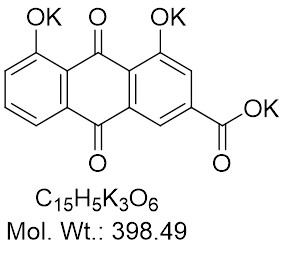
 K-Rhein
AOB11188
CAS: 478-43-3 (non-salt parent)
Chemical Name: Rhein triporassium salt; 4,5-Dihydroxyanthraquinone-2-carboxylic acid tripottasium salt
992 Items
Molarity Calculation Cart®
HOW TO ORDER
Quantity Discount Table - Order More To Get More Price Discount
| Quantity | mg | Unit Price ($/mg or $/Unit) | Final Price |
|---|---|---|---|
| 1 | 5 | $50.15 | Total: $250.75 |
| 1 | 10 | $42.48 | Total: $424.80 |
| 1 | 25 | $35.99 | Total: $899.75 |
| 1 | 50 | $30.68 | Total: $1,534.00 |
| 1 | 100 | $26.55 | Total: $2,655.00 |
Data sheet
| Molecular Formula | C15H5K3O6 |
| Molecular Weight | 398.49 |
| CAS Numbers | 478-43-3 (non-salt parent) |
| Storage Condition | 0°C (short term), -20°C (long term), desiccated |
| Solubility | DMSO Aqueous |
| Purity | 95% by HPLC |
| Synonym | Potasium Rhein; Rhein K; Rhein Tripotasium |
| IUPAC/Chemical Name | 4,5-Dihydroxyanthraquinone-2-carboxylic acid tripottasium salt |
| References | 1) Eran Blacher et al., Inhibition of glioma progression by a newly discovered CD38 inhibitor; IJC, 136:1422 (2015) |
More info
K-Rhein, also known as rhein tripotassium salt (CAS 478-43-3), is a synthetic derivative of rhein, a naturally occurring anthraquinone compound found in plants like Rheum palmatum (rhubarb) and Cassia tora. K-Rhein is primarily utilized in research to study its effects on various biological processes, particularly its role in inhibiting the enzyme CD38 that affects NAD⁺ metabolism, calcium signaling, and downstream cellular processes, making it a valuable tool in neuroprotection, metabolic research, and epigenetic studies. Its use is research-only, with no approved clinical applications.
Mechanism of Action
K-Rhein functions as a CD38 inhibitor. CD38 is an enzyme involved in the metabolism of NAD+ and the regulation of intracellular calcium levels. By inhibiting CD38, K-Rhein can influence cellular processes such as energy metabolism, immune response, and neuroprotection.
Biological/Functional Effects
| Functional Area | Effect of K-Rhein |
|---|---|
| Calcium signaling | Reduces intracellular calcium flux via CD38 inhibition |
| Energy metabolism | Maintains NAD⁺ levels, potentially improving mitochondrial function |
| Neuroprotection | In preclinical studies, protects neurons from oxidative stress and excitotoxicity |
| Immune modulation | CD38 inhibition can affect immune cell activation and cytokine release |
| Metabolic research | Used to study NAD⁺-dependent pathways, aging, and metabolic diseases |
Functional Applications
CD38 Inhibition: K-Rhein is used to study the effects of CD38 inhibition on cellular functions and its potential therapeutic applications.
Neuroprotection: Research suggests that K-Rhein may have neuroprotective effects, potentially offering insights into treatments for neurodegenerative diseases.
Metabolic Studies: By modulating NAD+ metabolism, K-Rhein serves as a tool to explore metabolic pathways and their implications in various diseases.
Caution
While K-Rhein is a valuable research tool, its use is primarily confined to laboratory settings. Its pharmacokinetics and potential side effects in humans are not well-studied, and it is not approved for clinical use.